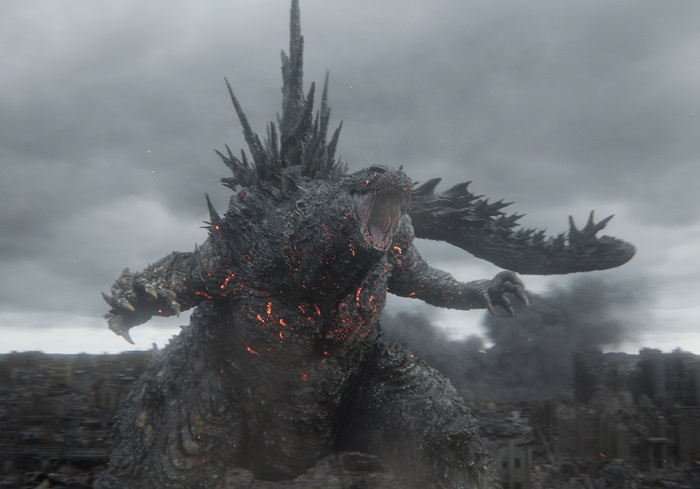
With Godzilla Minus One earned an Oscar for Best Visual Effects hopes were high for its sequel. Opening in early November 2026 ”Godzilla Minus Zero” stomped to a massive $63 million worldwide bow, led by a scorching $31.6 million North American debut and an additional $31.4 million from international territories. The R-rated monster sequel shattered the long-standing domestic milestone for the largest opening ever for a live-action foreign-language film, comfortably besting the previous high-water mark set by Zhang Yimou’s martial arts spectacle “Hero,” which opened to $17.8 million in 2002. Globally, “Godzilla Minus Zero” brought in $21.3 million from Imax screens alone, capturing 34% of its worldwide total and establishing a new record for the highest global Imax opening ever for a Japanese title. With a tight budget and excellent effects both these films are superior to the Hollywood incarnation and so we take a closer look and this is how they made Godzilla Minus Zero roar
Visual design challenged new heights as the first Japanese film to adopt the “Filmed For IMAX” format. The fighter planes featured in the film were custom-built as physical props, and the iconic Wako building in Ginza was meticulously measured on its actual rooftop to be recreated as a full-scale physical set. The material composition of Wako’s exterior walls were also researched to achieve ultimate realism, down to how sound waves would bounce off the structure. From the previous film, the VFX team expanded from 35 members to over 50. While this may still sound like a small crew, the team maintained its “elite core” approach. The team chose to stay true to the style established in Godzilla Minus One: knowing who is doing what task, who is currently struggling with what problem, and who is delivering exceptional shots—supporting and inspiring each other to build a great work together. Regarding VFX, a longer pre-production period was scheduled compared to the last film, establishing a system to maximize visual quality ahead of the theatrical release.
Streamlined production made Godzilla Minus Zero roar…
Because the director personally handles the script, storyboards, and VFX design, the team built an exceptionally efficient production line compared to large-scale Hollywood projects. During pre-production, thorough communication established a clear divide between “what is built as physical sets” and “what is expanded by Shirogumi via VFX,” ensuring that all departments shared a unified visual goal long before filming began.
A creative synergy built on tacit understanding…
The crew, having worked with the director for many years, operated autonomously based on the storyboards, maximizing Shirogumi’s company culture—where everyone from junior staff to veterans freely contributed ideas and proposals. Because the set moves toward the goal along the shortest possible path without waste, the team succeeded in delivering a massive visual scale within limited time and budget constraints.
Extensive horizon work, dynamic aerial combat, further evolved water simulations, and the imposing dignity and destructive force of the monster itself—all these upgraded VFX expressions were designed not merely for flashy display, but to tie intimately into the drama of the characters. Ultimately, this fusion of human drama and spectacle is the core identity of this work, marking a new high point for Japanese Godzilla cinema.
The first Japanese production filmed for IMAX….
Director Takashi Yamazaki: I felt the screen wouldn’t hold up unless we crafted the world far more meticulously, so we put a tremendous amount of work into the CG modeling, finer details of the sets, and character expressions. What I paid particular attention to was making the audience feel the “wind” when shooting outdoor scenes on a set. Because a large set prevents wind from reaching everywhere, we prepared huge fans, ran them on low settings, and devised ways to subtly rustle the characters’ clothing. That allowed us to express the outdoor air atmosphere effectively, but naturally, the fan noise was picked up, requiring us to re-dub the dialogue in post-production. It was tough on the cast and crew, but seeing the finished footage, we managed to dramatically capture an outdoor atmosphere even on a stage setup, so I’m glad we did it. Because IMAX conveys every fine detail, I was conscious of sharpening our focus within the practical live-action environment. Also, because the screen size is large, deciding on frame compositions that worked regardless of whether it was screened in CinemaScope, standard IMAX, or full IMAX was extremely challenging, though it was an interesting experience
The biggest challenges in how they made Godzilla Minus Zero roar….
Director Yamazaki: Keeping the entire frame in a state of “overcast sky” at all times was extremely difficult. Since the monster arrives along with dark clouds, it couldn’t be sunny. However, during outdoor location shoots, there were many sunny days, and ideal cloudy skies were rare. That left us with no choice but to shoot inside a stage, but we had to reproduce scenes of people running around or driving cars in a vast area of ruins under a continuous cloudy sky. The only outdoor-style ground we could prepare was a “20m x 8m paved space,” so we made full use of it. By changing decorations and rubble placement, or making it look like it was near various buildings, we shot people frantically running while making every cut look like a different location. I realized how hard it is to control the weather, but since the finished footage looks as though the camera moved across many locations, I consider it a success.
The approach to visual effects …..
Director Yamazaki said, ‘I went in believing that if I became conscious of the award, I would lose. Winning was a truly wonderful experience and an extraordinarily rare time, but when we were making Godzilla Minus One, we weren’t thinking about awards at all. Focusing on that would cloud our perception, so without being conscious of it at all, I only thought about pouring all of our skills into creating VFX that would elevate the film. Therefore, the approach itself was identical to the previous film. How we rack our brains over the VFX process dictates the quality, so we conducted repeated research to shoot scenes that normally couldn’t be captured by making full use of ideas and tricks. That process is entertainment for us, and when something shot through absurd methods ends up as a cool shot, it’s the ultimate happiness’.
He continued,’Thankfully, the number of people increased slightly to around 50, and we approached it with a larger team than usual. However, there are an enormous number of effects this time. Because two giant monsters exist, effect animations occur everywhere. There are sky depictions, ocean scenes, and an abundance of mysterious beams and heat rays. Therefore, this time as well, I stuck to the set while stumbling from exhaustion, giving real-time instructions like “let’s do this here” to reduce the time lag until decisions were made, thoroughly maintaining our conventional approach. I painfully realized that just because the team grows doesn’t mean the work becomes easier; rather, what we try to pull off simply becomes more luxurious’.
…..and that’s how they made Godzilla Minus Zero roar!
related feature : Massive Monsters, Super Size Sets – The Making of Godzilla v Kong…….
related feature : ‘Godzilla King of the Monsters’ – London premiere with Millie Bobby Brown